



How to buy a diamond you want when you’re on a budget? You want a beautiful engagement ring but you’re worried that the only way to buy one is to spend beyond a budget that you can afford. You’re not alone on this. With diamond jewelry marketed to cost more than cars, it’s a fair assumption to make.
The good news? It doesn’t matter if your budget is $1,000, $3,000, or even less. It is possible to buy a diamond engagement ring that matches your specific budget without sacrificing the ring design you are hoping for.
But before doing so, it’s important to understand the reason for the high value of diamonds and why some are expensive and some are affordable.
Why Are Diamonds Expensive?
The value of a diamond is determined by its quality. The assumption most people make is that diamonds are rare and that natural earth-mined diamonds are difficult to extract from the earth, and therefore they are expensive. It is true that it takes an entire mining industry to extract diamonds from the earth, but to say that they are rare is not accurate. In fact, according to Bain & Company, around 133 Million Carats are extracted each year.
What is rare is to find a perfect diamond that is colorless and does not have any inclusions, imperfections, or cloudiness. The perfect diamond is so rare that how diamonds are valued depends entirely on this concept. For example, diamonds that are colorless are more expensive than diamonds with a tint of color. Diamonds that have no visible inclusions are more expensive than diamonds with natural marks and inclusions.
Because diamonds form within the earth’s crust, at a depth that humans can not reach, the way they form can not be controlled. The perfect diamond can only be discovered, but not created; making these the most valued in the market.
How to Buy a Diamond When You’re on a Limited Budget
One thing that you’ll notice when shopping for engagement rings is that two identical diamonds can be sold at significantly different prices. In one case, you’ll find a 1 carat round diamond engagement ring priced at around $8,000. On the other hand, you’ll find another 1 Carat round diamond engagement ring for about $4,000-$6,000. If you’re lucky, you can even find a 1 Carat engagement ring for under $4,000.

It might seem odd to have two different prices set on very similar diamonds, but it’s completely valid that one diamond can cost twice the price of another. The important factor to consider when learning how to shop for a diamond when you’re on a budget is to understand what makes diamonds expensive, and what are the possible ways to work around this. Our guide shares the top six tips for getting the diamond you want without going beyond your desired budget.
1. Choose a Slightly Colored Diamond
The color of a diamond is one of the 4 C’s that determine its selling price. The color grade of a diamond varies from colorless to light yellow; the colorless being the most expensive.
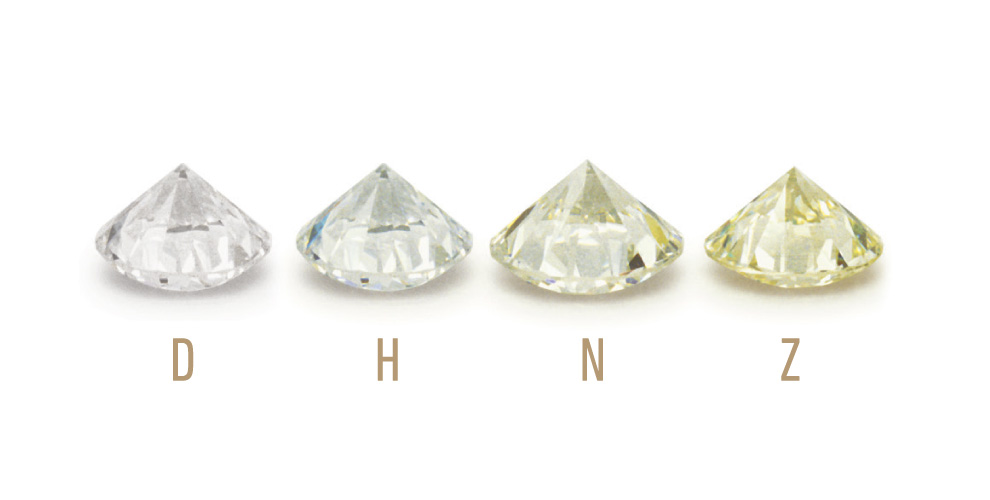
The jewelry market will encourage you to shop for colorless diamonds as these are considered to be the best choice. What you might not know is that it is possible to get a diamond that appears colorless to the naked eye but is actually slightly colored, and therefore, is cheaper in price.
The diamond color grades of G, H, I, and J fall under the Near Colorless grading category. These diamonds have the faintest hint of color that can only be seen with a powerful light and magnifying tool.
A 1 Carat Diamond Ring with a Near Colorless grading can sell for anywhere between $6,000 to $10,000.
The diamond color grades K, L, and M are categorized as Faint diamond color grading and can sell anywhere between $4,000 to $6,000.
If your goal is to shop for a diamond with a limited budget, we recommend that you choose a diamond with a Faint diamond grading (K, L. M). These are not noticeably colored to the naked-eye.
ADDITIONAL TIP – CHOOSE A RING DESIGN THAT CREATES THE ILLUSION OF A COLORLESS DIAMOND
- Select a yellow gold or rose gold setting: By pairing a lower color graded diamond with a yellow or rose gold ring, the diamond will look colorless. This yellow gold halo ring is a great example of a ring to pair with a lower color graded diamond, like a J-K colored diamond.
- Add a fancy color diamond or gemstone to your ring design: Whether you prefer a halo ring or one with side stones, adding colored gemstones can make your center diamond look colorless in contrast with the darker colored gemstone. Consider placing smaller amethysts or topaz stones alongside your diamond.
- Ensure accent diamonds are the same color grading as your center stone: If there are other diamonds besides the center stone on your ring, make sure that their color grade is the same as your center diamond. When the side diamonds have a higher color grade, it will make the center diamond look more colored.
- Go with a solitaire setting: By choosing a plain solitaire in rose or yellow gold, your center diamond won’t have to compete with the surrounding diamonds. This yellow gold solitaire band is a beautiful choice for a lower-color diamond. The diamond will look colorless next to the band and you won’t have to worry about the color of any smaller diamonds.
1 carat diamond engagement ring example within a $3,000 budget: 1 Carat Princess Cut Toscana Ring in Yellow Gold with H color
2. Opt for a Lower Clarity Diamond
While having a pristine diamond with no blemishes seems enticing, it’s not always realistic — or necessary. To save a little on your engagement ring, you can opt for a diamond with inclusions that are not visible to the naked eye. These diamonds are also referred to as ‘eye-clean’ diamonds. Their inclusions are only visible with the use of bright light and magnifying tools; hence they look blemish-free to the naked eye.
Lower clarity diamonds are more affordable because of their lower clarity grading. Have a look at the price comparison of different Clarity Grades of 1 Carat Diamonds:
| CARAT | CLARITY | CUT | COLOR | PRICE |
| 1 | SI2 | EXCELLENT | H | $4,100 |
| 1 | SI1 | EXCELLENT | H | $5,200 |
| 1 | VS2 | EXCELLENT | H | $5,800 |
| 1 | VS1 | EXCELLENT | H | $6,000 |
| 1 | VVS1 | EXCELLENT | H | $6,500 |
Important Consideration: You’ll need to consider that it is possible that two diamonds with the same clarity grading will look different. One may be eye-clean without any large visible inclusions, and another may have very visible inclusions. It’s important to see the diamond in person before making a purchase.
What to avoid with lower clarity diamonds:
- Avoid cloudy diamonds because they don’t offer as much sparkle and can appear dull.
- Visible needle chips made from the cutting process
- Visible cavities or black spots that make the diamond look dirty
- Large blemishes that make a diamond look attractive
Use Your Ring Setting to Cover blemishes

For a lower clarity diamond, it’s often best to put it in a ring setting that’s intricate with lots of enticing details, like this unique halo ring. The design draws focus away from the center diamond and allows the total piece to stand out as a work of art. The more intricate the ring design is, the less noticeable the inclusions will be.
1 carat diamond engagement ring example within a $3,00 budget: This intricate setting allows the eyes to focus more on the total design than the center stone. It would be perfect for a lower clarity diamond, such as an SI1 or lower.
3. Buy a Clarity Enhanced Diamond
If you’re hoping to shop for the lowest possible diamond prices without settling for an unattractive diamond, it’s recommended to consider clarity-enhanced diamonds.
How does a clarity-enhanced diamond help your budget? Clarity-enhanced diamonds cost approximately 50% less than non-enhanced diamonds. You basically get a beautiful and clean natural diamond at the price of a lower clarity grade diamond.
What is a Clarity-Enhanced Diamond?
A clarity-enhanced diamond is a natural earth-mined diamond that has undergone treatment to hide its inclusions. This is done by inserting microscopic material to fill significantly visible inclusions. After the enhancement, the inclusions will no longer be visible, even under magnification.
What you need to know about Clarity Enhanced Diamonds:
- Clarity enhancement does not affect the diamond in any negative way.
- The enhancement lasts for a lifetime even with everyday wear.
- The only way that a clarity-enhanced diamond can be damaged is by applying extreme direct heat of over 1,000 degrees to the diamond or submerging the diamond in ammonia-based acids. Otherwise, the enhanced diamond will remain safe and unaffected.
- Clarity enhancement treatments can also be redone if ever needed. In fact, treating a diamond a second time is so rare that at Brillianteers, we offer this service for free.
4. Pick a Certificate Other than GIA
Diamonds are graded by gemological labs for qualities like color and clarity. These certifications determine the value of a diamond and how much it should be sold for. There are many gemological labs, including GIA, EGL, DGC, IGI, HRD, and IGL. Each lab has its own standard of grading that differs from one lab to another.
The GIA laboratory is the strictest lab entity and the most well-known certification. Because of this, diamonds that are GIA-Certified are also sold for a higher price compared to diamonds that are certified by other laboratories. A big misconception is that GIA-certified diamonds are better than other diamonds. This is not true. The strict grading process of GIA means that they have set a higher standard for the way they grade diamonds and therefore they seem to have the best diamonds. But in fact, other laboratories provide the same quality diamonds but are not as meticulous with the grading process as GIA.
Save money on your diamond by avoiding a GIA CERTIFICATION. The certification of a diamond has one main purpose; to confirm the authenticity of a diamond and grade the 4 C’s. It’s not necessarily important what laboratory provides a diamond’s certification for as long as the laboratory is recognized by the industry as a reliable source for certifications.
Here’s a look at all the available diamond certificates:
| Diamond Certification | Gemological Laboratory |
| DGC diamond certification | Diamond Gemological Certification |
| AGS diamond certification | Diamond Gemological Certification |
| GIA diamond certification | Gemological Institute of America |
| GSI diamond certification | Gemological Science International |
| SGL diamond certification | Solitaire Gem Labs |
| IGI diamond certification | International Gemological Institute |
| GCAL diamond certification | Gem Certification & Assurance Lab |
| EGL diamond certification | European Gemological Laboratories |
| HRD diamond certification | Hoge Raad voor Diamant, Diamond High Council |
1 carat diamond engagement ring example within a $3,000 budget: Here is a beautiful rose gold three-stone engagement ring with a DGC diamond.
Bonus tip: Set aside concerns about reselling your diamond. You may be worried about the resale value of your diamond and how the lab certificate might impact that. It’s important to know that all diamonds lose approximately 50% of their value when resold. That’s because diamonds are a retail product and are resold at wholesale prices.
5. Compromise on Carat Weight
A diamond’s price increases significantly when it reaches a full carat mark. For example, a 0.75 Carat Solitaire Engagement Ring costs around $1,200 to $1,700. While a 1.00 Carat Solitaire Engagement Ring can cost around $1,600 to $2,800. The price difference is significant despite the fact that the size difference of the diamonds is only 0.25 Carats. This is because a full Carat of a diamond is always sold at a higher price than that of a diamond that is just a little short of the same weight. The two diamonds look almost identical in size, but the price gap makes the biggest difference.
Below 1 carat, diamond prices drop significantly because many people want to hit that 1-carat mark. But if you choose a slightly smaller carat weight, the diamond can look just as big, but cost a lot less. For only half a MM in diameter difference, you can save hundreds of dollars. You can also put more of your budget towards a better color or clarity grade; if that’s what you want.
To help your budget, consider a diamond ring with lesser carat weight, like this 0.75 carat in a halo setting. There are even a few ways to make your smaller stone appear larger.
Choose a Halo Ring

A halo engagement ring has smaller diamonds that decorate the center stone. You could choose a .5, .6, or .7 carat diamond and then surround it with smaller stones to give the illusion of a bigger diamond. You could also go with a double halo setting, like this white gold design, to make the diamond seem even bigger. With the right ring, you can make a .6 carat diamond look like a 2 carat diamond.
Consider a cluster ring
Another good tip on how to buy a diamond ring when you’re on a budget is to consider a cluster ring. A cluster setting is a ring that doesn’t have one center stone, but several slightly smaller diamonds clustered together to form the appearance of a larger stone. You can save a lot of your budget with a cluster ring, but still, end up with a beautiful engagement ring. A cluster ring can have 3 or 4 diamonds next to each other in the center, like this princess-cut cluster ring.
1-carat diamond engagement ring example within a $3,000 budget: This halo ring is a beautiful example of a 0.75 center stone and a 1.50 total carat weight.
6. Ask for a Second Opinion
An important tip is to always ask for a second opinion. Sorting through all the diamond choices all on your own can be exhausting, and sometimes, confusing. It’s hard to know where to get the best value for your budget.
It’s helpful to get a second opinion from an experienced jewelry expert who can help suggest the best diamonds and engagement rings based on your budget and what’s important to you. Reach out to us at any time, and we will help you narrow down the options and offer our top recommendations.
Depending on what you want and your preferences and budget, we will help you find a perfect fit.
1 carat diamond engagement ring example within a $3,000 budget: One of our favorite 1 carat diamond rings is this split shank halo ring with smaller diamonds detailing the band.
Conclusion: Focus on What’s Actually Important
First and foremost, when you’re figuring out how to buy a diamond ring, nothing is more important than the way the diamond looks in your ring. That is more important than its specs and its certificate.
There are five key ways to get the diamond you want within your budget:
- Get a lower color and a Yellow or Rose Setting
- Get an included diamond in a more unique setting and make sure to handpick the right diamond
- Get a Clarity Enhanced Diamond which is both white and clean
- Get a non-GIA certified Diamond
- Get a slightly smaller diamond and a halo setting to complement it
The smaller details, such as the exact color grade, become less important over time. The imperfections you can see under a microscope won’t matter. The lab name on your certificate won’t matter. The size of your diamond and how white and beautiful it is will matter. As the years pass, you’ll be admiring the diamond on your hand (or your partner’s) and how it looks to you is the most important factor of all.
Still want help narrowing down your choices? Contact us and we’ll offer recommendations for the best engagement rings and diamonds within your budget.