


The most common question couples ask when shopping for an engagement ring: “What can I actually get for my budget?” The honest answer depends entirely on where you shop. A $3,000 budget at Blue Nile buys a very different ring than a $3,000 budget at Brillianteers — and the gap will surprise you.
Use the tool below. Pick your budget, and see what’s available across three categories: the big-brand retailers, affordable natural diamonds, and lab-grown options at the same price.
Disclaimer: Prices shown for third-party retailers are estimates based on market research. They were compiled by reviewing multiple products across each retailer at each price point and represent approximate averages only. These are not live prices, not guaranteed prices, and not a commitment from any retailer listed. Actual prices will vary significantly based on current stock, exact diamond specifications, setting choice, and promotions. This information is provided solely to give buyers a general sense of how budgets compare across different shopping options — it is not intended to be relied upon as accurate pricing. Brillianteers prices reflect actual products currently available on our site and are accurate as of the date of publication but are subject to change based on diamond availability.
Why is there such a big price difference?
The answer depends entirely on which category you’re looking at. The reasons are completely different in each case.
Big-brand retailers: all roughly the same
If you compare Blue Nile, James Allen, and Brilliant Earth side by side, you’ll find prices are broadly consistent. All three are large operations with substantial advertising budgets and brand premiums built into their pricing. There’s variation at the individual diamond level — different stones, slightly different specs — but no meaningful structural price advantage from one to another. They’re competing on brand and user experience, not price.
Affordable natural diamonds: a very different story
This is where the gap opens up, and for real reasons.
Online retailers without physical showrooms, commissioned sales staff, or mall locations operate at a fundamentally lower cost structure. No showroom rent, no salespeople on commission, no celebrity endorsements. The best ones pass those savings directly to the buyer.
But there’s a second factor that matters just as much: the diamonds themselves are not interchangeable. Not every retailer has access to the same stones. Brillianteers has active buyers at every major diamond exchange in the world. The diamonds we source are evaluated and purchased directly — they don’t pass through additional layers of wholesalers, each adding margin. A diamond you buy from us has been acquired as close to the source as possible. That’s not something a mall jeweler or department store chain can offer, and it’s a significant part of why our price points are where they are.
Lab-grown diamonds: almost entirely a markup question
Lab-grown diamonds cost roughly the same to produce regardless of who sells them. The price you pay is almost entirely a function of the retailer’s margin. No supply chain scarcity, no mining cost variability — just what the seller adds on top. When a retailer operates lean, that saving flows directly to you. That’s why the spread in lab-grown pricing across retailers can be dramatic.
Frequently asked questions
Are Brillianteers diamonds certified?
Yes. We offer diamonds with multiple types of independent certification depending on the stone and your budget. Some of our diamonds carry a GIA certificate, some are IGI-certified, and others carry a DGC certificate. The specific certification varies by diamond and price point. If a particular type of certificate matters to you, reach out before purchasing and we’ll match you with the right stone.
Is a lab-grown diamond a real diamond?
Yes. A lab-grown diamond is a real diamond — chemically, optically, and physically identical to a mined diamond. Same carbon crystal structure, same hardness (10 on the Mohs scale), same light performance. The difference is origin: a mined diamond formed underground over billions of years; a lab diamond is grown in a controlled environment in weeks. Neither a gemologist nor a grading laboratory can tell them apart visually.
Does buying from a lesser-known retailer pose a risk?
It can — but not for the reasons most people assume. The real risk isn’t about which certificate comes with the stone. It’s about whether the retailer actually knows what they’re doing and has a track record of standing behind their products.
The rapid growth of lab-grown diamonds over the past few years brought a wave of new storefronts that appeared almost overnight to capitalize on demand. Many of these operations have no deep roots in the diamond trade and no meaningful industry experience. Buying from a company that launched two or three years ago carries real risk.
Our recommendation: buy from retailers who have been in the diamond industry for a long time and are genuinely established — whether that’s Blue Nile, James Allen, Brilliant Earth, or us.
Brillianteers has been in the diamond industry for over 30 years. We maintain active buyers at every major diamond exchange in the world:
- New York
- Antwerp
- Belgium
- Israel
- Mumbai
- India
- Hong Kong
That depth of industry presence means we know the market, know how to evaluate quality, and know how to source correctly. The advantage for you is that we bring all of that expertise without the overhead of a retail chain — the savings come directly to you.
Can I upgrade my diamond to a larger stone later?
Yes. Brillianteers offers a diamond upgrade program that allows you to apply the value of your original diamond toward a larger or higher-quality stone in the future. This makes starting with a smaller stone a lower-stakes decision — you’re not permanently locked in. Confirm the current terms with us directly before purchasing, as conditions can vary depending on the stone and time elapsed.
Why do natural diamond prices jump so sharply at higher carat weights — but not lab-grown?
Natural diamonds are rare. A 2-carat natural diamond is not simply “twice the price of a 1-carat” — it costs significantly more because finding a single piece of rough gem-quality material large enough to yield a 2-carat finished stone is far rarer than finding two separate pieces that each yield 1 carat. At each significant size threshold — 0.50ct, 1.00ct, 1.50ct, 2.00ct — prices jump noticeably because rarity increases exponentially with size, not linearly.
Lab-grown diamonds don’t face this constraint. They’re manufactured, so producing a 3-carat stone requires more time in the growth chamber — not a lucky geological find. The economics are fundamentally different, which is why the pricing curve for lab diamonds stays relatively flat at scale. A 4-carat lab diamond costs a fraction of what a 4-carat natural diamond costs, and the gap widens the larger you go.
What’s the biggest diamond I should consider? Is a 5-carat diamond too big?
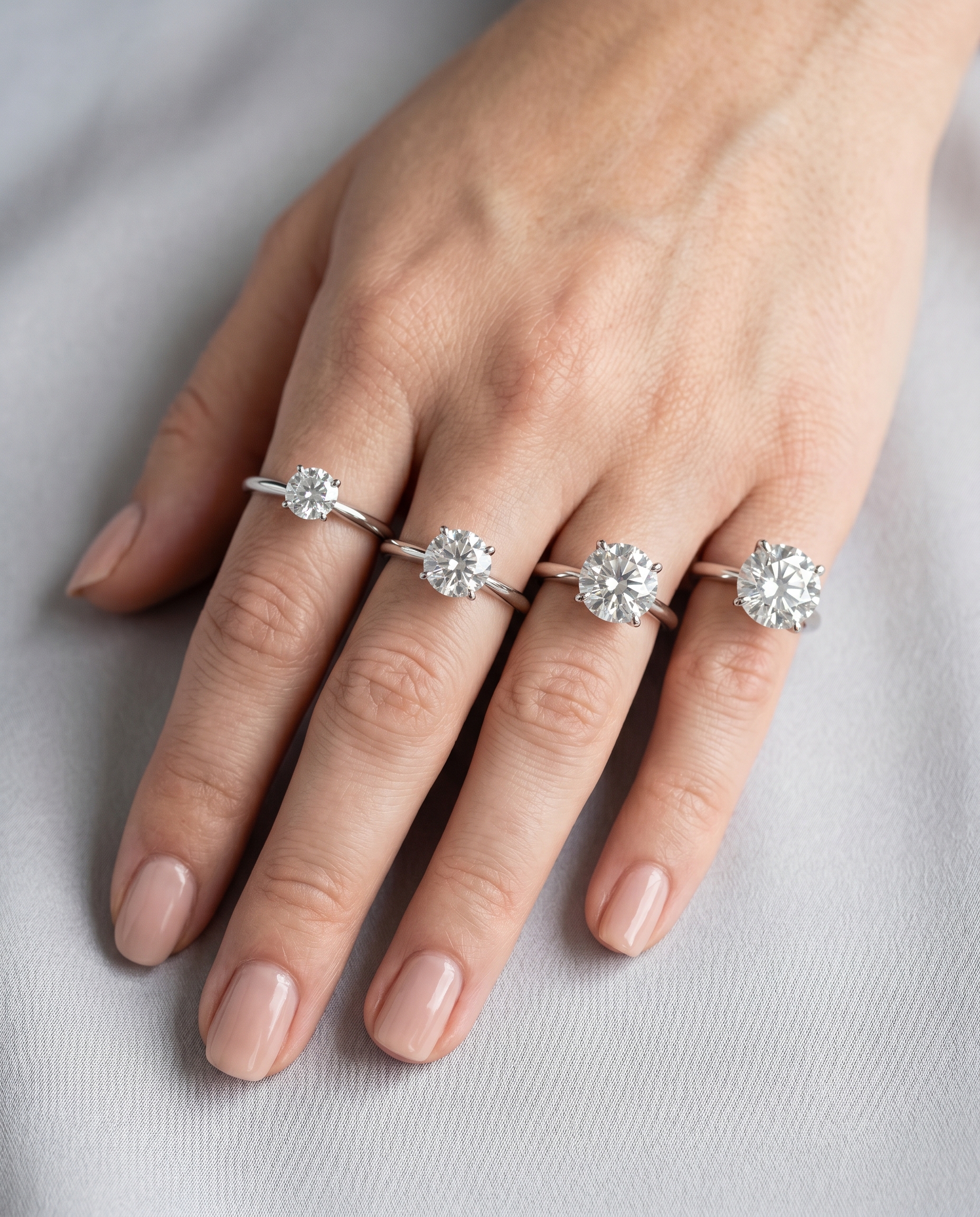
There’s no universal answer — it depends on hand size, personal style, and lifestyle. But some practical guidance:
For everyday wear, most people find 1–2 carats comfortable and practical. A 3-carat stone is a genuine statement piece. A 5-carat natural diamond is quite rare — when worn daily, it brings real considerations: it can snag on fabric, it’s visually commanding on most hand sizes, and it attracts a level of attention not everyone is comfortable with.
Lab-grown diamonds shift the calculus. Because a 5-carat lab stone is far more affordable, buyers sometimes size up more than they would have with a natural diamond. The stone is equally beautiful — the practical question is whether the wearer actually wants to wear something that size every single day.
If you’re seriously considering anything above 3 carats, try on comparable-sized rings in person before committing. The difference between what looks striking in a photo and what feels right on your hand every day can be significant.
What is the difference between natural and lab-grown diamonds when it comes to value over time?
In terms of appearance: none. They are visually identical. In terms of long-term value retention: natural diamonds have historically held their resale value better than lab-grown diamonds.
Lab-grown diamond prices have dropped significantly over the past several years as global production has scaled. A lab diamond purchased in 2021 may be worth considerably less at resale today. Natural diamonds are also subject to the standard retail-to-resale discount that all diamonds carry — but the decline has been more gradual and more stable for natural stones.
Neither natural nor lab-grown diamonds are reliable investment vehicles. If resale value matters to you, a natural diamond is the more conservative choice. But most people buy an engagement ring to wear it, not to sell it.
What are the 4 Cs, and which one matters most?
The 4 Cs — cut, color, clarity, and carat — are the standard framework for evaluating a diamond. Here’s how to think about each:
- Cut is the most important. It determines how much light the diamond returns to your eye — the brilliance and sparkle. A well-cut stone in a lower color grade will often look more beautiful than a poorly cut stone with superior color and clarity. Don’t compromise on cut.
- Color grades run from D (colorless) to Z (visibly yellow). For most buyers, diamonds in the G–H range appear white to the naked eye when set in white gold or platinum, and represent strong value compared to D–F colorless grades that are hard to distinguish without a side-by-side comparison.
- Clarity measures internal inclusions and surface blemishes. SI1 is typically eye-clean and is where most experienced buyers focus. SI2 can also be eye-clean but should be evaluated stone by stone.
- Carat is weight, not physical size — though they’re closely related. Carat weight has the most dramatic impact on price, especially for natural diamonds. Small differences at key thresholds can mean significant price changes.
How much should I actually spend on an engagement ring?
The “two months’ salary” rule was invented by a De Beers marketing campaign in the 1940s. It has no factual basis. The right budget is one that doesn’t create financial pressure and reflects what matters to both of you.
If a larger stone matters and lab-grown diamonds get you there within a comfortable budget, that’s a rational decision. If a natural diamond is the priority and a smaller stone is what the budget allows, that’s equally valid. Neither is wrong — they’re different priorities.
What we’d suggest: set the budget first. Then work backward to find the best stone at that number. Don’t reverse-engineer a budget to justify a stone you’ve already fallen for in a photo.
What metal should I choose for the ring setting?
The most common choices are 14K white gold, 18K white gold, yellow gold, rose gold, and platinum. Here’s a quick guide:
- 14K white gold is the most popular for engagement rings — durable, affordable, and pairs well with most diamonds. Requires rhodium replating every few years to maintain its white color.
- 18K gold has a higher gold content (75% vs 58% for 14K), giving it a richer feel and slightly warmer tone. More expensive and slightly less scratch-resistant.
- Platinum is the most durable and naturally white — it doesn’t require replating. More expensive upfront but holds up better over decades of daily wear.
- Yellow gold and rose gold are having a strong resurgence. Rose gold in particular pairs beautifully with warmer-toned diamonds. Worth considering if the wearer gravitates toward warmer tones.
What ring style is most popular right now?
The solitaire remains the most enduring choice — a single stone, clean lines, nothing competing with the diamond. It’s timeless and works at every budget.
Halo rings (a center stone surrounded by a ring of smaller diamonds) were dominant for about a decade and are trending slightly down among younger buyers, though they remain popular. They make the center stone appear larger, which helps at tighter budgets.
Three-stone rings have seen a resurgence — the two side stones traditionally represent the past and future, and the style adds visible diamond weight without a dramatic budget jump. Oval and elongated cuts are also very popular right now, partly because they tend to look larger face-up than a round of the same carat weight.
Can I customize the ring setting?
Yes. Brillianteers offers a range of settings — solitaire, halo, pavé, three-stone, and more — in multiple metals including 14K and 18K white gold, yellow gold, rose gold, and platinum. If you have something specific in mind, reach out and we’ll walk you through what’s available.
What if the ring doesn’t fit?
Ring sizing is one of the most common concerns with online purchases. Brillianteers offers resizing assistance — most rings can be adjusted up or down. If the fit isn’t right after delivery, contact us with your order details and we’ll take care of it.
Ready to see what’s available at your budget? Browse the full Brillianteers engagement ring collection — natural diamonds and lab-grown options in every style. Free shipping and 30-day returns.