


In This Guide
Diamond prices are not straightforward. Two diamonds of the same carat weight can differ in price by 300% based on cut quality, color, clarity, and where you buy them. This guide gives you real, current price ranges for lab grown diamonds by carat size and shows you exactly how that compares to natural diamonds in 2026.

Lab Grown Diamond Price Table by Carat (2026)
The table below covers full ring prices — diamond plus setting — for IGI-certified lab grown diamonds in round brilliant, G color, VS2 clarity, Excellent cut, set in a 14k white gold solitaire. Natural diamond prices are included for comparison. All figures reflect 2026 market rates from reputable online retailers.
| Carat Size | Lab Grown (Ring) | Natural Diamond (Ring) | Savings vs. Natural |
|---|---|---|---|
| 0.5 carat | $400 – $800 | $1,500 – $2,500 | ~72% less |
| 1 carat | $900 – $1,800 | $4,000 – $7,000 | ~75% less |
| 2 carat | $2,000 – $4,500 | $12,000 – $20,000 | ~78% less |
| 3 carat | $4,500 – $9,000 | $25,000 – $42,000 | ~80% less |
| 4 carat | $8,000 – $16,000 | $55,000 – $90,000 | ~83% less |
| 5 carat | $14,000 – $28,000 | $90,000 – $150,000+ | ~84% less |

To put these numbers in context: the budget for a 1-carat natural diamond gets you a 3-carat lab grown diamond ring or a 4-carat lab grown diamond with money to spare. The size difference is visible across a table.
Price Comparison Chart: 1, 2, and 3 Carat Diamonds
The visual below shows how dramatically lab grown and natural diamond prices diverge as carat weight increases. The gap is significant at 1 carat — but at 3 carats it becomes almost incomprehensible. A 3-carat natural diamond costs roughly five times more than a 3-carat lab grown of equivalent quality. Both are real, certified diamonds.
What Affects the Price Within Each Carat Size
Two 1-carat lab grown diamonds can differ in price by $800 or more depending on their specs. Cut grade is the most impactful factor — it determines how much a diamond sparkles. Color and clarity grades above the eye-clean threshold have diminishing visible returns. Shape also affects price significantly: round brilliant is the most expensive shape per carat, while oval and cushion typically run 10–20% less.
Here’s how to think about each factor:
Cut: Always buy Excellent or Very Good. A well-cut H/SI1 diamond will outshine a poorly cut D/FL every time. This is the one spec to never compromise on regardless of budget.
Color: G or H is the value sweet spot. D–F colorless grades cost significantly more but look identical to G in most ring settings. For yellow or rose gold settings, you can go as low as J with no visible color.
Clarity: VS2 is ideal. Eye-clean SI1 stones exist and can save 15–25% over VS2 — always view real photos of the specific stone to confirm no visible inclusions before buying SI1.
Shape: Round brilliant is the most expensive shape per carat. Our 2-carat lab grown diamond rings include round, oval, cushion, and other shapes — oval and cushion typically come in 10–20% lower for the same carat weight.
Price by Shape (Same Carat Weight)
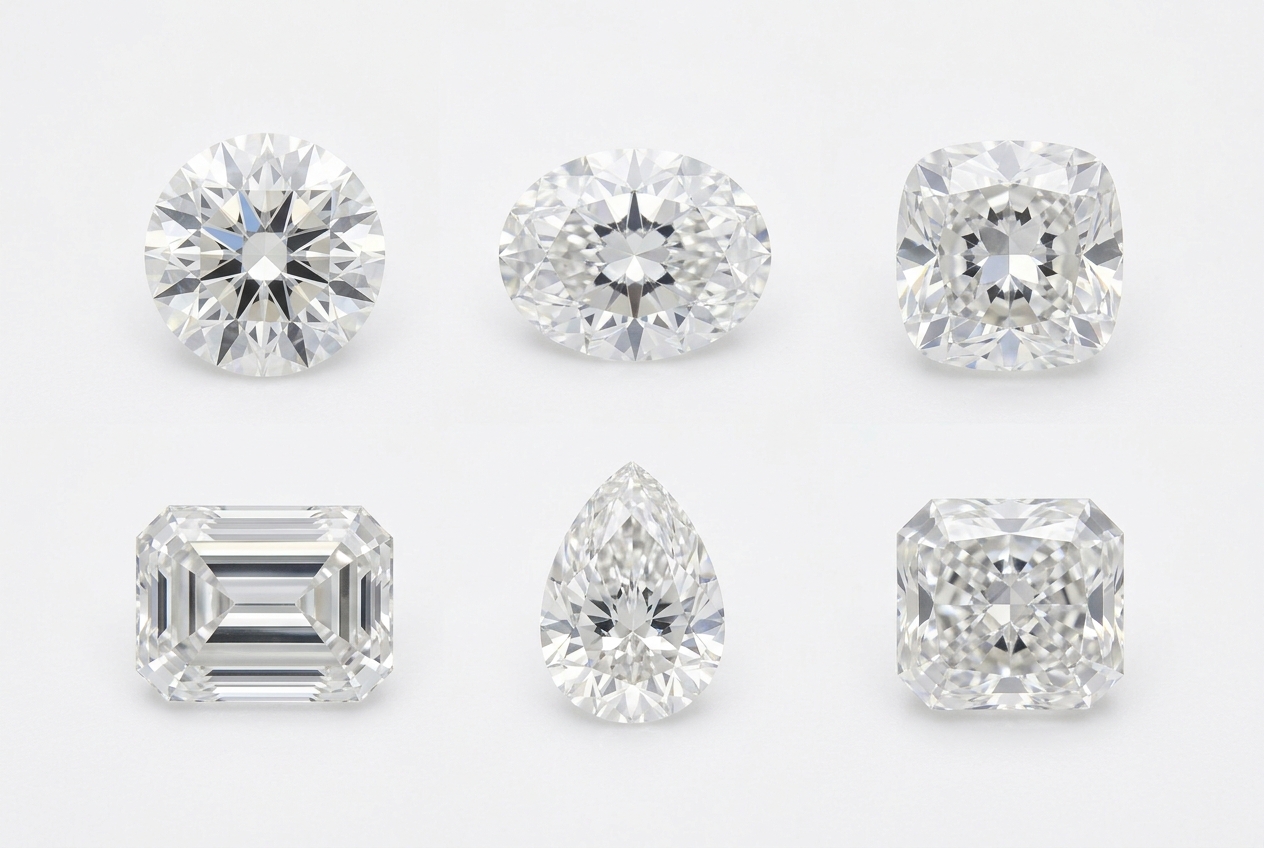
Diamond shape has a meaningful impact on price per carat. Round brilliant commands the highest price because it requires the most rough diamond to produce and is the most in-demand shape globally. All other shapes — called fancy shapes — cost less per carat for equivalent quality grades. The price difference between round and oval or cushion at the same carat weight can be 15–25%.
| Shape (1 Carat, VS2/G) | Approx. Price (Lab Grown) | Notes |
|---|---|---|
| Round Brilliant | $900 – $1,800 | Most popular, highest price per carat |
| Oval | $750 – $1,500 | Appears larger than round, finger-lengthening |
| Cushion | $700 – $1,400 | Romantic, vintage feel, soft corners |
| Emerald Cut | $650 – $1,300 | Step-cut elegance; clarity matters more |
| Pear | $700 – $1,400 | Teardrop shape, elongates the finger |
| Princess | $750 – $1,500 | Square, geometric, requires protective setting |
Frequently Asked Questions
How much does a 1-carat lab grown diamond ring cost in 2026?
Approximately $900–$1,800 from a reputable online retailer for an IGI certified, VS2/G, excellent cut round brilliant in white gold solitaire. The range reflects differences in cut quality, color grade, and retailer pricing. Brillianteers prices 1-carat lab grown rings starting around $900, with premium grades reaching $1,600–$1,800.
How much does a 2-carat lab grown diamond ring cost?
Approximately $2,000–$4,500 in VS2/G, Excellent cut in 2026. The same natural diamond would run $12,000–$20,000. Browse our 2-carat lab grown diamond rings — the 2-carat oval is particularly popular and looks significantly larger than a 2-carat round at typically lower prices.
How much does a 3-carat lab grown diamond ring cost?
Approximately $4,500–$9,000 in 2026. Equivalent natural diamonds range from $25,000–$42,000. See our full range of 3-carat lab grown diamond rings. The price gap widens at larger sizes because large natural diamonds are significantly rarer.
Are lab grown diamond prices still falling?
Yes. Prices have fallen 60–75% since 2020 and continue to decline as growing technology scales. There’s no meaningful reason to wait — the savings available today are already extraordinary, and waiting longer doesn’t guarantee lower prices at the quality tier most buyers want.
What is a fair price for a lab grown diamond?
A fair price has an IGI certificate you can verify independently, clearly listed specifications, and pricing consistent with 2–3 competing retailers. For a 1-carat VS2/G round Excellent, prices across reputable retailers should be within 15–25% of each other. Significant outliers in either direction warrant scrutiny.
Why are lab grown diamonds cheaper than natural?
Because they can be manufactured at scale. A lab grown diamond can be produced in 2–4 weeks using HPHT or CVD technology. As global production capacity increased, supply outpaced demand and prices dropped significantly. The diamonds themselves are physically and chemically identical to natural — the only difference is origin and supply.
Is a lab grown diamond from Brillianteers the same quality as James Allen or Blue Nile?
Yes, if the specifications match. IGI certification is the independent verification — once you verify the certificate number on IGI’s website, quality is established regardless of retailer. Brillianteers sources from the same wholesale markets built on 20+ years of industry relationships, which is why pricing tends to be 10–25% below major competitors for equivalent certified stones.

Shop Lab Grown Diamond Rings at Brillianteers
IGI-certified lab grown diamonds from 0.5 to 5+ carats. Transparent pricing, no retail markup.