


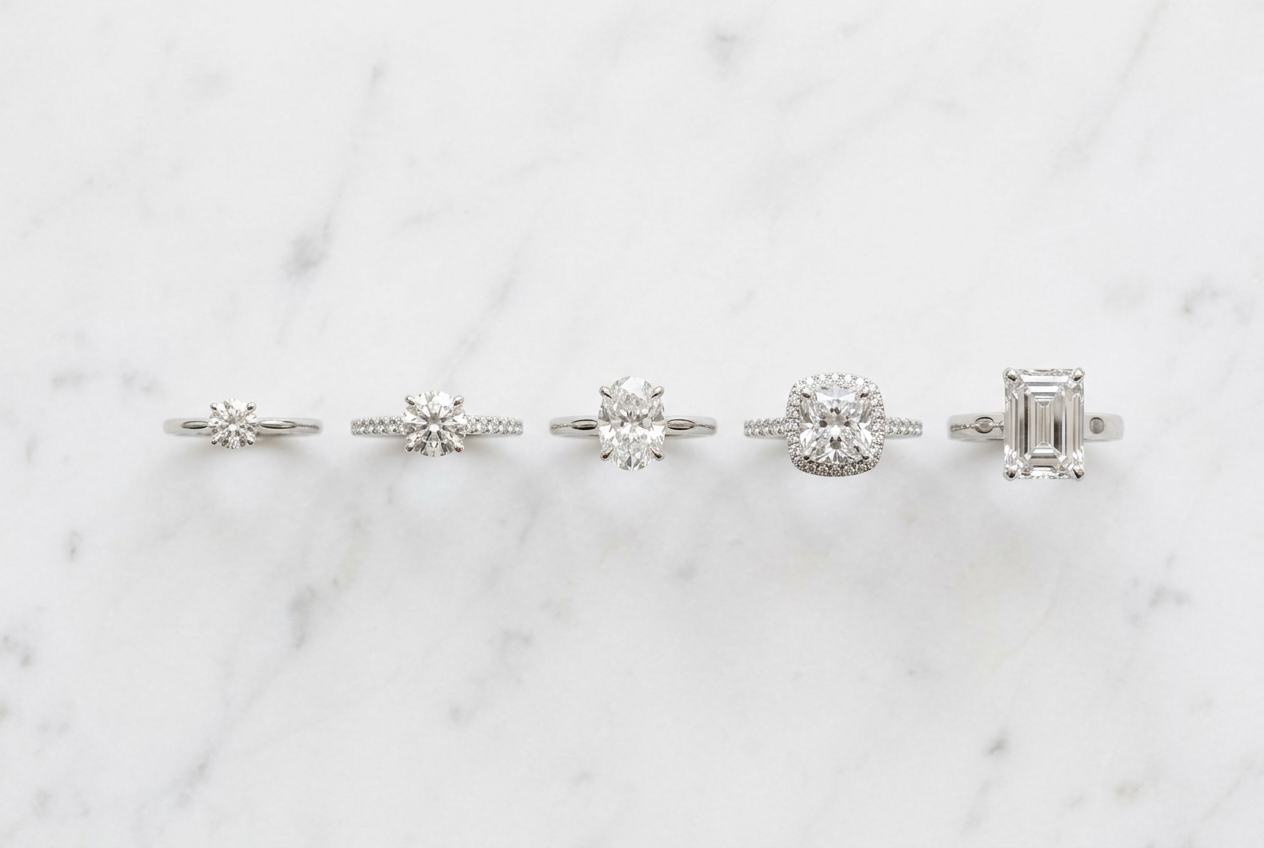
In This Guide
Engagement ring budgets are one of the most searched and least clearly answered topics in jewelry. The “three months salary” rule is a marketing invention from De Beers in the 1980s. What you should actually spend depends on what you want the ring to look like and how much you can afford without financial stress.
This guide breaks down what your budget actually gets you in 2026, across lab grown and natural diamonds, at real market prices.

Lab Grown vs Natural Diamond Prices: A Visual Comparison
The single biggest budget decision is whether to buy a lab grown or natural diamond. Lab grown diamonds are chemically and physically identical to natural diamonds — same hardness, same certification, indistinguishable to the naked eye. In 2026 they cost 70–80% less. For a 1-carat solitaire in VS2/G, Excellent cut: lab grown runs about $1,400; natural runs about $5,500. That difference compounds significantly at 2 and 3 carats.
See our full 2-carat lab grown diamond rings and 2-carat natural diamond rings to compare side by side what each price tier delivers in practice.
What Your Budget Gets You in 2026
Lab grown diamonds have redefined what each budget tier can deliver. A $1,000 budget that would have bought a tiny, low-quality natural diamond five years ago now gets you a 1-carat IGI-certified ring. A $3,000 budget that might have stretched to a half-carat natural now gets you a 2-carat-plus lab grown. The cards below show realistic expectations at each price point.
$500 – $1,000
Lab grown 0.5–0.8ct round brilliant or oval, VS2/G, IGI certified, classic solitaire in sterling silver or 10k gold. This range is real and meaningful — not a compromise. Browse rings under $2,000 to see what’s available.
$1,000 – $2,000
Lab grown 0.9–1.2ct, VS2/G or better, Excellent cut, IGI certified. White or yellow gold solitaire. This is the sweet spot for most buyers — a ring that looks genuinely impressive at a price that doesn’t require years of saving. See our 1-carat diamond ring collection.
$2,000 – $3,500
Lab grown 1.3–1.8ct, VVS clarity or F color upgrades available, or an oval/cushion at 1.5–2ct. Halo and pavé settings in 14k gold. At this range, you have real flexibility across size, shape, and metal. Explore our 1.5-carat diamond rings.
$3,500 – $5,000
Lab grown 2ct+ in premium grades, or 1ct+ natural diamond in VS2/G. Custom settings, platinum, side stones. If you want a 2-carat lab grown ring that photographs beautifully, this budget handles it comfortably.
$5,000+
Lab grown 3ct+ or natural 1.5ct+ in high grades. Three-stone designs, pavé bands in platinum. Explore our 3-carat lab grown diamond rings or lab diamond bridal sets at this tier.
Where to Spend and Where to Save
Every dollar in an engagement ring budget has a different return on what you actually see on the finger. Cut quality has the highest visible impact per dollar — a well-cut diamond sparkles dramatically more than a poorly cut one. Clarity and color above the eye-clean threshold have the lowest visible impact — the difference between VS2 and VVS1 is invisible without magnification. Metal choice also affects budget significantly, with platinum costing 30–40% more than white gold for the same appearance.
| Factor | Spend here | Save here |
|---|---|---|
| Cut grade | Always buy Excellent/Ideal | Never compromise — cut determines sparkle |
| Clarity | SI1 is eye-clean for most stones under 2ct | VVS is invisible to the naked eye — save the difference |
| Color | G–H is the value sweet spot | D–F looks identical to G in most ring settings |
| Shape | Oval/cushion appear larger per carat | Round brilliant costs more per carat than any other shape |
| Metal | 14k white gold is durable and beautiful | Platinum costs ~40% more for minimal visible difference |

Frequently Asked Questions
How much should you spend on an engagement ring in 2026?
Spend what you can afford without financial stress. The “three months salary” rule is a 1980s marketing campaign by De Beers, not a financial principle. Beautiful, certified rings are available from around $800–$1,000 for lab grown options. What matters is the ring’s quality and meaning, not the amount spent.
Is $1,000 enough for an engagement ring?
Yes, comfortably. At $1,000 you can buy a 0.9–1ct lab grown diamond in VS2/G color with an Excellent cut grade from a reputable retailer. This is a certified, genuinely beautiful stone in a solid gold solitaire. The idea that $1,000 is a low budget for an engagement ring is outdated — lab grown pricing changed that reality in the last three years.
Are lab grown diamonds worth buying for an engagement ring?
Yes, for buyers focused on the ring itself rather than its resale value. Lab grown diamonds are chemically and physically identical to natural diamonds and cost 70–80% less for the same size and quality. The tradeoff is that they don’t hold resale value — but neither do most natural diamonds purchased at retail. If you’re buying a ring to wear, lab grown is an excellent choice in 2026.
What size diamond can I get for $2,000?
At $2,000 for a lab grown diamond ring, you can realistically expect a 1.2–1.5 carat round brilliant or a 1.5–1.8 carat oval in VS2/G, Excellent cut, IGI certified, set in 14k white or yellow gold. Check our current rings under $2,000 for exact availability.
Should I buy a natural or lab grown diamond?
Lab grown if: you want the most impressive-looking ring for a given budget, you’re not concerned about resale value, and you want full price transparency. Natural if: you value rarity and the ring as a long-term asset, your partner has specifically requested a natural stone, or you’re buying a size where natural scarcity matters. Neither is universally right — it depends on what you prioritize.
How do I avoid overpaying for an engagement ring?
Shop online from specialist retailers rather than physical jewelry stores — retail markups are typically 100–200% over wholesale. Compare identical specifications across at least two retailers before buying. Use IGI certificate numbers to verify grades independently at igi.org. Avoid retailer-branded or in-house certifications.
Does Brillianteers offer financing?
Yes. Brillianteers offers financing options that make higher-budget rings accessible without requiring full upfront payment. Check the site for current terms and approval requirements, available for both lab grown and natural diamond purchases.

Shop Engagement Rings at Brillianteers
Lab grown and natural diamonds. IGI certified. Priced below major retailers on equivalent stones.