



Updated May 2026 · By Brillianteers · 9 min read
The most reliable method is borrowing one of her existing rings and having it measured at a jeweler — this gives you an exact size in under two minutes. If that’s not possible, five other approaches work with varying degrees of precision. This guide covers all six, ranked from most to least accurate, plus what to do if you get it wrong.
Table of Contents
- Method 1: Borrow One of Her Rings
- Method 2: Use a Ring She Owns as a Template
- Method 3: Measure While She Sleeps
- Method 4: Ask Someone Who Knows
- Method 5: The String or Paper Method
- Method 6: Make an Educated Guess
- Ring Size Chart: US, UK, and EU Sizes
- Tips That Apply to Every Method
- What to Do If You Get the Size Wrong
- FAQ
Method 1: Borrow One of Her Rings
The gold standard. Take a ring she wears on her ring finger, bring it to a jeweler, and have them slide it onto a ring mandrel to get the exact size. Most jewelers will do this in under two minutes for free. You get a precise number — no guessing involved.
The key details to get right: make sure the ring is worn on her left ring finger specifically (finger sizes vary between hands and between fingers), and borrow it for long enough to get it measured without raising suspicion. A common approach is to take it while she’s sleeping or in the shower, get it measured at a nearby jeweler the same morning, and return it before she notices.
If you can’t get to a jeweler, use the ring sizing chart below. Place the ring flat on a piece of paper, trace the inside circle, and measure the diameter in millimeters. Match that measurement to the chart to find her US ring size.
Method 2: Use a Ring She Owns as a Template
If you can’t borrow the ring long enough to visit a jeweler, you can still use it to get a size. Two approaches work well here.
First: place the ring over the circles on a printable ring sizing chart. Most jewelers offer these as free PDFs — Brillianteers has one at this link. Match the ring’s inner circumference to the closest circle and read the size directly.
Second: trace the inside of the ring onto a piece of paper, then measure the diameter of that circle in millimeters with a ruler. Use the size chart in this article to convert that measurement to a US ring size. A diameter of 16.5mm is a size 6, 17.3mm is a size 7, and so on.
Accuracy with this method depends on keeping the ring perfectly flat and tracing carefully. It’s reliable to within half a size, which is close enough for most ring purchases since resizing is always an option.
Method 3: Measure While She Sleeps
This works, but it requires care. When someone is relaxed, their fingers are typically at their smallest — which means a ring sized this way may feel slightly loose when she’s active or in warm weather. For this reason, if you go this route, consider sizing up a quarter to half size from what you measure.
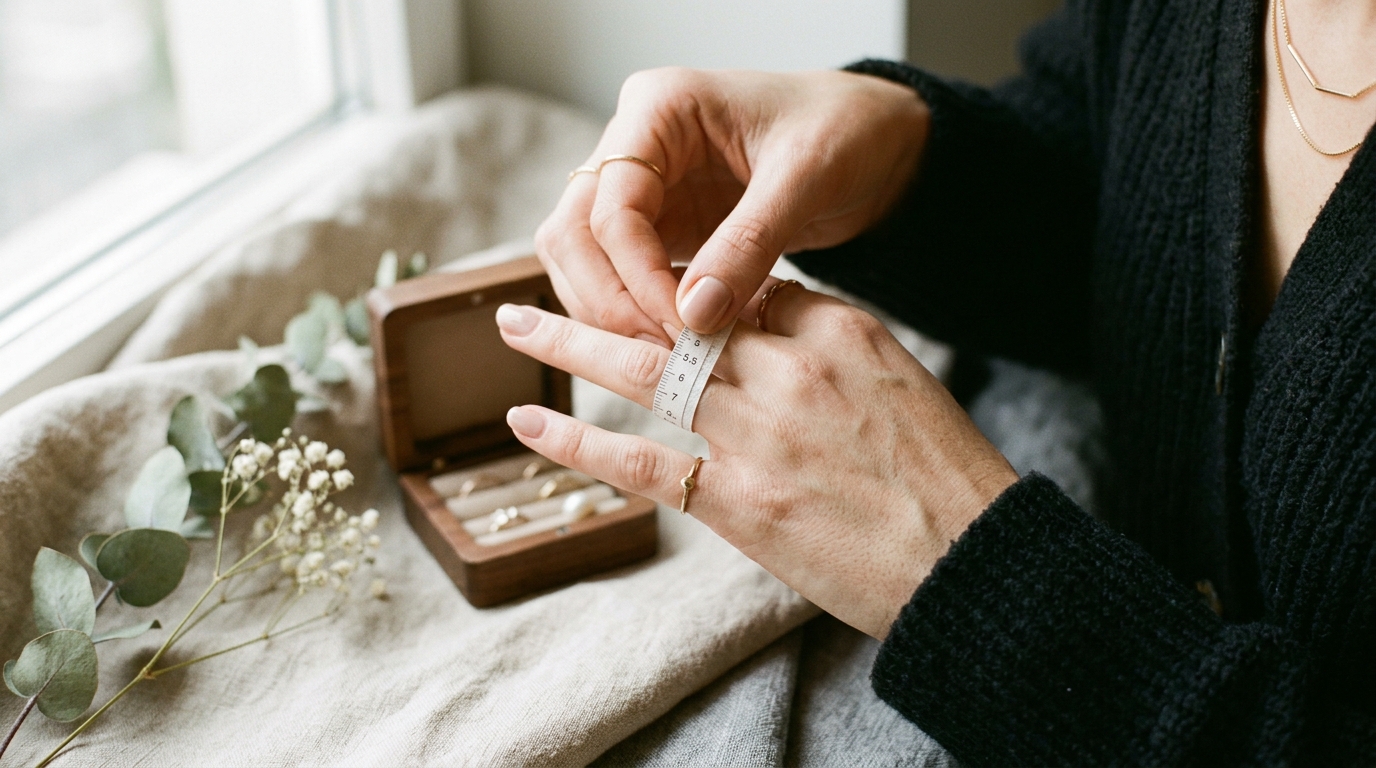
Use a thin strip of paper or a piece of string (not stretchy). Wrap it snugly around the base of her ring finger on her left hand — snug but not tight. Mark where it overlaps, then lay it flat and measure the length in millimeters. That number is her finger’s circumference. Use the chart below to convert circumference to ring size.
Alternatively, use a ring sizer tool — a set of plastic or metal sample rings in graduated sizes. These are inexpensive and available online. If you have one, gently try different sizes on her finger while she sleeps to find the best fit. The advantage of a physical sizer over a string is that you’re testing actual fit, not just measuring.
Method 4: Ask Someone Who Knows
Her closest friends or her mother are often the easiest path to an accurate size — especially if she’s already hinted to them about wanting to get engaged. A trusted friend can ask casually, find out directly, and pass the information to you without spoiling the surprise.
This approach works best when you have a friend in her circle you can trust to be discreet. Let them know exactly what you need: the size she wears on her left ring finger, not just a general ring size. Some people wear different sizes on different fingers and different hands.
If she has a sister or mother who wears a similar-sized ring, that can also serve as a starting reference point — though it’s an approximation, not a measurement.
Method 5: The String or Paper Method
If you can’t measure her finger while she sleeps and don’t have access to her existing rings, the paper method is a workable alternative — though less precise. This works best as a casual activity framed as something fun.
Hand her a thin strip of paper and ask her to wrap it around her finger “to see how it fits” — perhaps while you’re doing a craft project together, or framed as a curiosity. Mark the overlap, measure it later, and convert using the chart. Done casually, she may not connect it to a proposal.
Another version: use a soft measuring tape (the kind used in sewing) and find a moment to wrap it around her finger under a plausible pretext. Measure in millimeters and convert.
The string method tends to run slightly large because strings conform to the finger. Subtract about 1–2mm from your measurement before converting to account for this.
Method 6: Make an Educated Guess
If none of the above is workable, an educated guess based on her body type and hand size is still a reasonable starting point. The average US ring size for women is between size 6 and 7. A woman with smaller hands and slender fingers is more likely to be a 5 or 5.5. A woman with larger hands or wider fingers may be a 7 or 7.5.
Compare her ring finger to one of your own fingers as a reference. If her finger looks similar to your pinky, a size 6 is a reasonable estimate. If it looks larger, adjust up.
When guessing, err slightly large. A ring that’s a little loose is easier to resize than one that won’t go past the knuckle. Going up half a size also means she can wear it immediately after the proposal, even if resizing happens later.
Ring Size Chart: US, UK, and EU Sizes
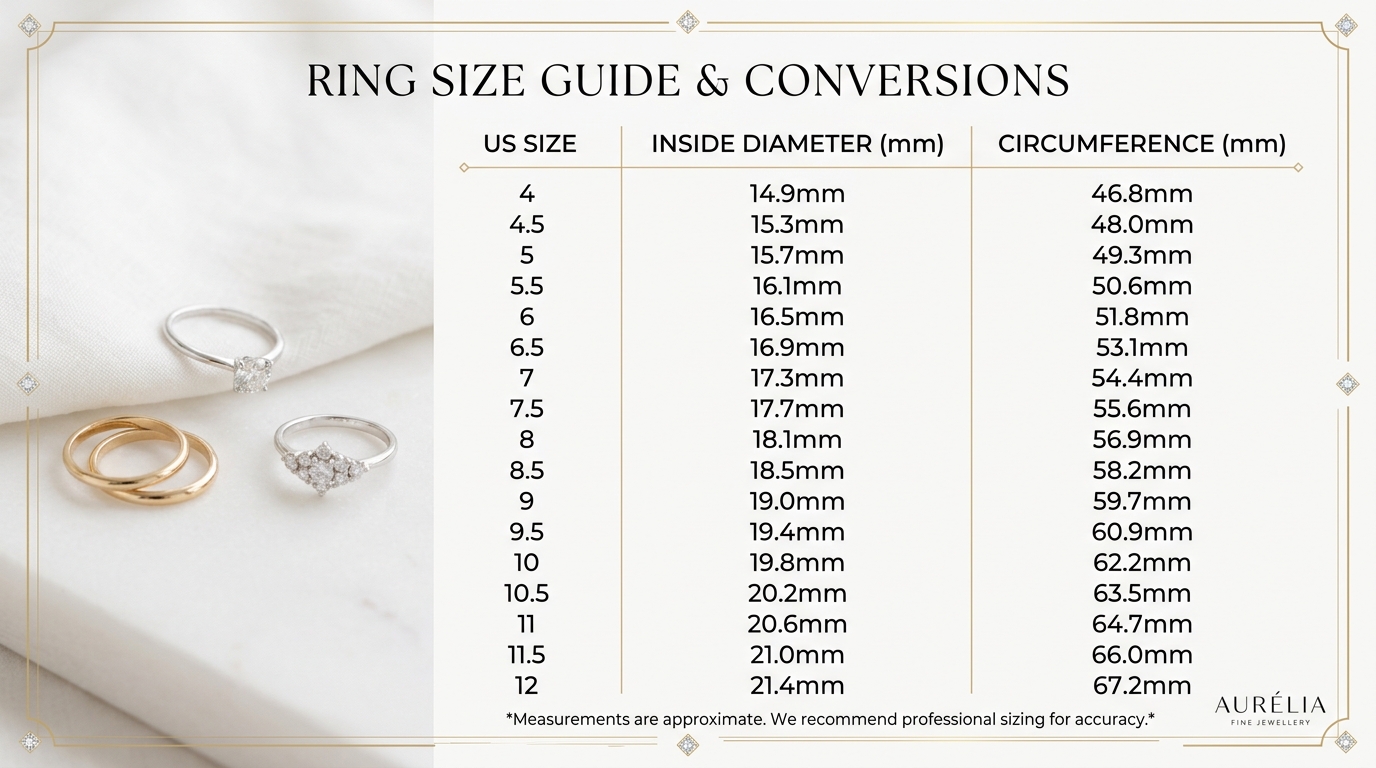
Use this chart to convert finger measurements to ring sizes. Diameter is measured across the inside of a ring or a traced circle. Circumference is the length of a string or paper strip wrapped around the finger.
| US Size | UK Size | EU Size | Diameter (mm) | Circumference (mm) |
|---|---|---|---|---|
| 4 | H | 46.5 | 14.8 | 46.5 |
| 4.5 | I | 47.8 | 15.3 | 47.8 |
| 5 | J½ | 49 | 15.7 | 49.3 |
| 5.5 | K½ | 50.3 | 16.1 | 50.6 |
| 6 | L½ | 51.5 | 16.5 | 51.8 |
| 6.5 | M½ | 52.8 | 16.9 | 53.1 |
| 7 | N½ | 54 | 17.3 | 54.4 |
| 7.5 | O½ | 55.3 | 17.7 | 55.7 |
| 8 | P½ | 56.5 | 18.1 | 57.0 |
| 8.5 | Q½ | 57.8 | 18.5 | 58.3 |
| 9 | R½ | 59 | 18.9 | 59.5 |
Tips That Apply to Every Method
Finger size changes throughout the day and with temperature. Fingers are typically at their largest in the afternoon and after physical activity, and smallest in the morning and in cold weather. If you’re measuring, mid-day in a comfortable room gives the most representative result.
The dominant hand (usually right) tends to be slightly larger than the non-dominant hand. Since engagement rings are traditionally worn on the left hand, make sure any measurement or borrowed ring comes from her left ring finger specifically.
Ring width affects fit. A wide band (5mm or more) sits differently on the finger than a thin solitaire band. Wide bands typically need to be ordered half a size larger to feel the same as a narrower ring at the same size. If you’re planning a wide-band design, factor this in.
The knuckle matters too. Some people have noticeably larger knuckles relative to the base of their finger. If the ring needs to clear a larger knuckle but sit snugly at the base, it may require custom fitting. This is less common in women’s engagement ring sizing, but worth noting if her knuckles are visibly pronounced.
What to Do If You Get the Size Wrong
Getting the size slightly wrong is extremely common — it happens in a significant portion of engagement ring proposals. It’s not a problem. Most rings can be resized up or down 1–2 sizes without affecting the setting or the diamond. The process typically takes 1–2 weeks and costs $50–$150 depending on the ring metal and the jeweler.
At Brillianteers, we offer a free resize within 60 days of purchase. There’s no need to get the size exactly right before proposing — arriving close is good enough. She can be measured properly after she says yes and the ring can be adjusted to a perfect fit before she starts wearing it daily.
If the ring is significantly off (more than 2 sizes), resizing becomes more complicated for certain settings and may affect the proportions of a pavé or channel-set band. For those cases, it’s worth contacting the retailer to discuss options before proceeding. Our team at Brillianteers is available to advise on sizing and resizing for any ring we carry. See our VS1 vs VS2 clarity guide and diamond color grade guide for help choosing the right stone to pair with your chosen setting.
One other option: propose with a placeholder ring. Some buyers choose to propose with a simple band or a stand-in ring and then shop for the engagement ring together afterward. This removes the sizing guesswork entirely and lets her be involved in the design process. It’s less of a surprise, but it guarantees she gets exactly what she wants — both in size and style.
FAQ
What is the most accurate way to find out her ring size secretly?
Borrowing one of her existing rings and having it measured on a ring mandrel at a jeweler is the most accurate method. It takes under two minutes and gives you a precise size. All other methods involve some degree of approximation.
What is the average ring size for women?
The most common women’s ring size in the US is size 6 to 6.5, with the majority of women falling between size 5 and 8. These are averages — ring size varies significantly with height, weight, and hand size. Don’t size based on average alone; try to get a direct measurement if possible.
Should I size up or down if I’m guessing?
Size up. A ring that’s slightly too large can be worn temporarily and resized. A ring that’s too small can’t go on the finger at all — which is a difficult moment at a proposal. Erring half a size large is the safer choice.
Can ring size change over time?
Yes. Fingers change size with age, weight changes, pregnancy, and temperature. A size that fit perfectly years ago may not fit the same way now. If you’re using an old ring as a reference, keep in mind it may reflect a size she wore years ago rather than her current size.
How do I convert ring size to millimeters?
US ring size corresponds to specific inner diameter measurements in millimeters. A size 6 has an inner diameter of 16.5mm and a circumference of 51.8mm. A size 7 is 17.3mm diameter and 54.4mm circumference. Use the full chart in this article for all sizes from 4 to 9.
What if she has different sizes on different fingers?
This is common. The dominant hand is often slightly larger than the non-dominant hand. Ring sizes also vary between fingers on the same hand — the ring finger is typically smaller than the middle finger. Always try to get a measurement or borrowed ring specifically from her left ring finger, not another finger.
Does Brillianteers offer free resizing?
Yes. Brillianteers offers a complimentary resize within 60 days of purchase. If the ring you propose with isn’t quite the right size, bring it back and we’ll adjust it at no charge. See our lab grown diamond guide for more on what to look for when selecting the ring itself.